
Traction Alopecia in Children: When Tight Styles Pull Too Hard

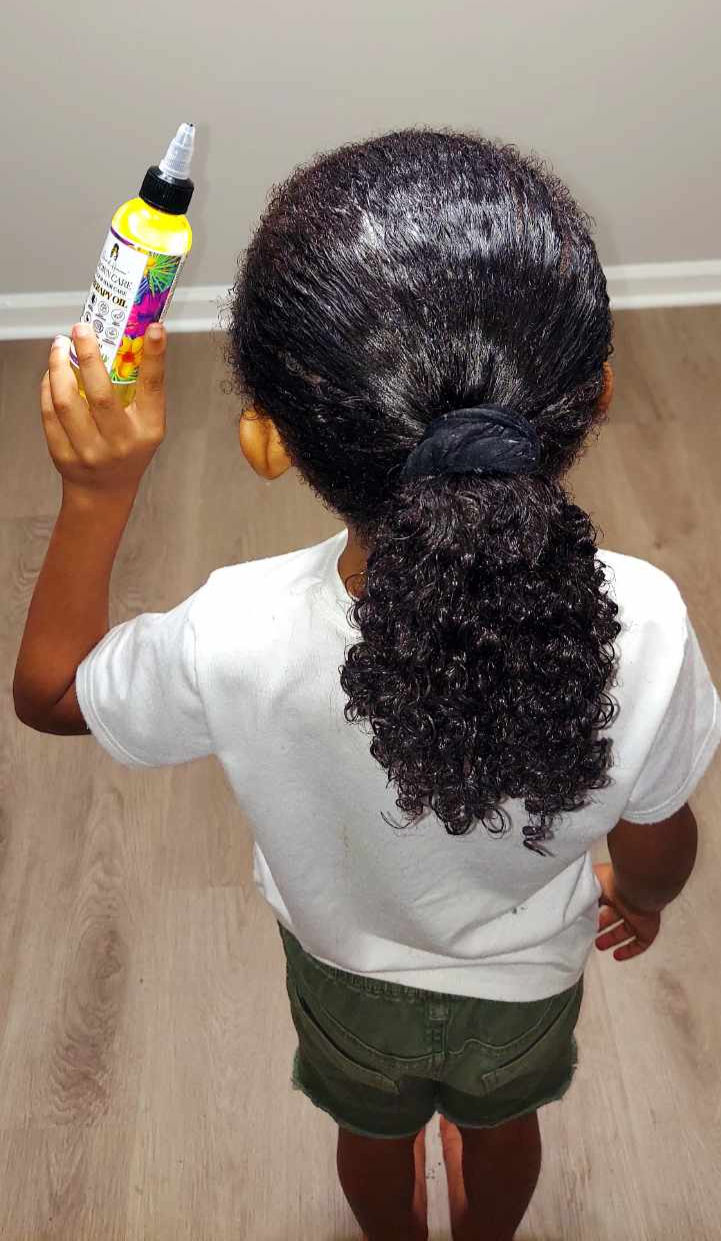
Tight braids, buns and ponytails can pull on a child’s hair roots hard enough to cause hair loss, and the earliest stage is the one that can still reverse. The American Academy of Dermatology puts the rule simply: if a hairstyle feels painful, it is too tight. For parents of mixed and biracial children, whose hair is often styled to protect it, knowing the difference between a protective style and a tense one is worth a few minutes.
What traction alopecia actually is
Traction alopecia is hair loss caused by repeated pulling and tension on the hair. A clinical review in the Indian Journal of Dermatology describes it as hair loss due to repetitive traction and tension, and the StatPearls medical reference from the National Library of Medicine explains that it follows two phases. Early on, the loss is non-scarring and reversible. If the pulling continues for years, the follicles can scar, and the loss becomes permanent.
That two-phase pattern is the whole reason this topic matters for parents. The same reference notes that hair loss from styling often begins in childhood, when it may still be reversible, which is why catching tension early is more useful than reacting late.
Why children are part of the conversation
The AAD has a section titled “Children can get traction alopecia, too,” noting that styling habits that lead to hair loss often begin at a young age. It also names girls and women of African descent among the groups at higher risk, along with ballet dancers and anyone who must pull their hair back for work.
Some numbers give a sense of scale. StatPearls cites South African data showing a prevalence of 8.6% to 21.7% among children aged 6 to 15, and a study of African American girls aged roughly 5 to 14 that found signs of traction alopecia in 18% of them. These figures come from specific populations and clinics, so they are not a prediction for any one child.
One honest limit: the sources we reviewed did not study mixed-heritage children as a separate group, so there is no number we can responsibly give for them. What the research describes is a mechanism, repeated tension on the follicle, and that mechanism depends on how a style is installed and how long it stays in, not on a label.
Which styles carry more tension
A Johns Hopkins review of 19 studies, published in the Journal of the American Academy of Dermatology, sorted common practices by risk. As summarized by ScienceDaily, the tiers looked like this:
Higher risk: braids, dreadlocks, weaves and extensions, especially on chemically straightened hair.
Moderate risk: thermal straightening, permanent waving and wigs.
Lower risk: loose, low-hanging styles, loose buns, and natural styles that avoid chemicals.
The AAD adds tightly pulled buns, ponytails and up-dos to its list, plus tight head coverings, especially if the hair is pulled back firmly before covering it. A hairline is often the first place to show strain.
Warning signs parents can check for
The AAD recommends checking monthly for the following, and treating any of them as a reason to change the style:
Broken hairs around the forehead or hairline.
A hairline that seems to be moving back.
Patches of thinner hair where the hair is pulled tightly.
Pain, stinging, crusts on the scalp, or the skin lifting into small peaks (the AAD calls this tenting).
A child who complains that a style hurts. Believe them and loosen or remove it.
Practical ways to lower tension
These are general habits that follow what the dermatology sources recommend, and every child’s hair and scalp is different:
Loosen the hairline. The AAD advises loosening braids, especially around the hairline, and switching styles so hair gets time to recover.
Mind the clock. Sources differ here. The AAD suggests keeping braids in no longer than 6 to 8 weeks, while the Johns Hopkins review is quoted saying two to three months for braids and 6 to 8 weeks for weaves and extensions. Ask your child’s dermatologist which fits your child.
Keep chemicals and heat out of the mix. The Indian Journal of Dermatology review recommends avoiding chemical and heat relaxing when styles are tight, and the AAD flags extensions on relaxed hair as a risk.
Alternate styles and take breaks. StatPearls recommends alternating hairstyles, reducing tension, and taking periodic breaks from extensions.
Cover hair loosely at night. The AAD suggests silk or satin head coverings, with hair pulled back loosely beneath them.
Gentler detangling before styling is also a sensible way to keep styling sessions comfortable. We found no research comparing detangling tools, so treat the two products below as comfort tools, not prevention.
Crown Care Detangling Hair Brush is one option for working through knots before a style goes in.
Silky Long Satin Bonnet is a satin covering for night, which pairs with the AAD’s advice to cover hair loosely.
When to see a dermatologist
The AAD says it is never too early to see a board-certified dermatologist about hair loss, and that the best way to stop it is to partner with one when symptoms first appear. This matters because, per the AAD, once traction alopecia advances, hair may not return. A pediatrician or dermatologist can also check whether something else, such as a scalp condition, is involved. We cannot diagnose a child from a description, and neither can a blog.
The takeaway is hopeful and practical: the early stage is the reversible one, and the changes that protect it are usually small. Looser tension, regular breaks and listening when a child says a style hurts cover most of what the research supports.
Sources
This article is for educational purposes only and is not medical advice. It is not intended to diagnose, treat, cure or prevent any condition. Talk with a qualified healthcare provider about skin or scalp concerns.

Comments